A good dash cam costs less than one fender-bender deductible. In 2026 you can get 4K recording, night vision, and even 3-channel coverage for under $100. We ranked the best-rated options on Amazon by real customer reviews.
Quick Picks
| Dash Cam | Best For |
|---|---|
| 70mai A810 Lite | Best Overall |
| 4K 3-Channel with 128GB | Best Value 4K |
| Icesky 4K 4-Channel | Best 360 Coverage |
| Pelsee 4K 3-Channel | Best Budget 3-Channel |
| Veement V200Pro | Best Budget |
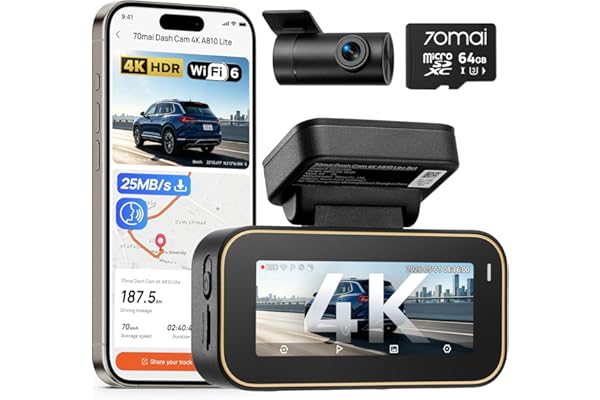
70mai A810 Lite 4K Dash Cam - Best Overall
The most proven pick on this list, with the deepest review history on the page. 4K front recording, 5GHz Wi-Fi 6 for fast phone transfers, GPS tracking, and 24-hour parking mode. This is the one we recommend to most drivers.
What buyers keep mentioning
- 4K front camera with HDR night vision
- 4G LTE remote access option
- 24H parking mode watches your car while parked
- Emergency lock preserves incident footage
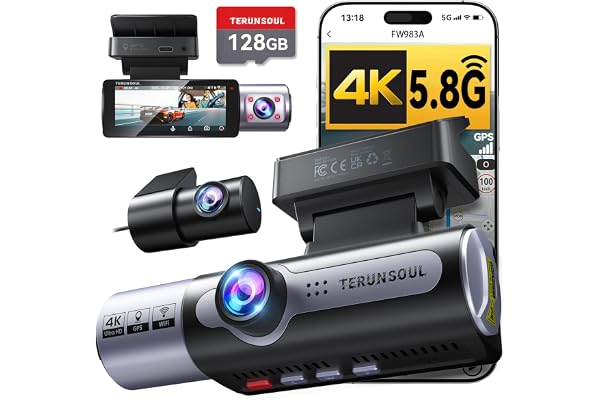
4K 3-Channel Dash Cam with Free 128GB Card - Best Value 4K
Front, rear, AND cabin coverage in one unit at a budget-friendly price. The included 128GB card means you are ready out of the box - no extra shopping. Its long, consistently positive review history puts it among the most trusted picks here.
What buyers keep mentioning
- 4K front + Full HD rear + interior camera
- Free 128GB card included
- Built-in 5.8GHz Wi-Fi
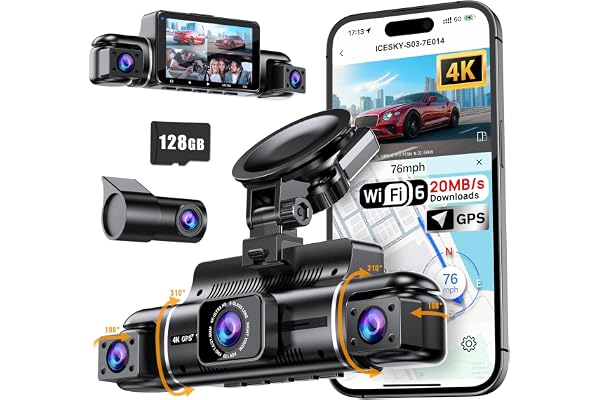
Icesky 4K 4-Channel Dash Cam - Best 360 Coverage
Four channels: front, rear, left, and right. If you drive in heavy city traffic or want total coverage, nothing else under $100 comes close. Includes a 128GB SD card and GPS.
What buyers keep mentioning
- True 4-channel 360 coverage
- 4K front + 1080P on the other three
- 8 IR lights for night vision
- WiFi 6 at 20MB/s transfers
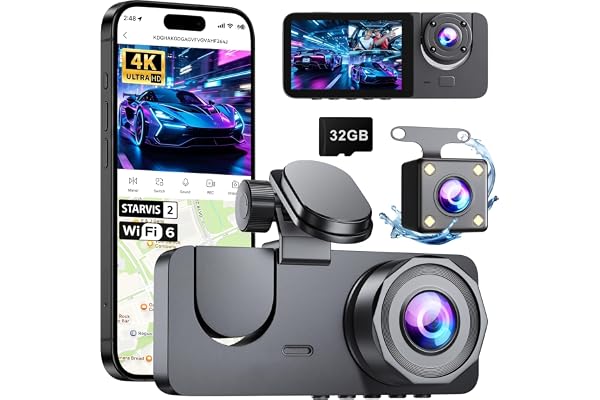
Pelsee 4K 3-Channel Dash Cam - Best Budget 3-Channel
Three cameras (4K front, 1080P cabin, 1080P rear) for well under the price of the 128GB bundle above. It is a younger listing with fewer reviews and a more mixed reception so far, so treat it as the budget way into full cabin coverage rather than the proven pick.
What buyers keep mentioning
- 4K front + 1080P interior + 1080P rear
- Cabin camera is useful for rideshare drivers
- Check Amazon for today's price
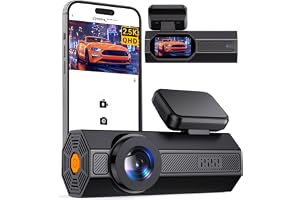
Veement V200Pro 2.5K Dash Cam - Best Budget
A budget-priced way to get 2.5K recording, WiFi, and a 1.47 inch screen. For rideshare drivers on a budget or a second car, this punches far above its price.
What buyers keep mentioning
- 2.5K front recording, F1.6 aperture
- WiFi app control
- 160° wide field of view
- Budget-priced
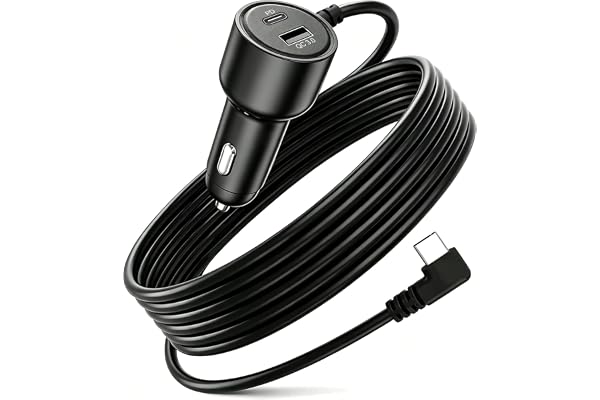
USB-C Dash Cam Power Cord - The Accessory You Need
Hardwiring your dash cam to a hidden USB-C port keeps your windshield clean and enables parking mode. It is well reviewed and inexpensive, so add it to any dash cam on this list.
What buyers keep mentioning
- Dual USB-C ports
- 11.5ft cord for clean installs
- Fast charging
Our Verdict
Most drivers should buy the 70mai A810 Lite - it has the deepest review history and the best brand support. Rideshare drivers and anyone wanting total coverage should grab the Icesky 4-Channel or the 4K 3-Channel with the free 128GB card. On a tight budget? The budget-priced Veement V200Pro is genuinely good.
What to look for in a dash cam:
- Resolution: 4K front is now standard under $100
- Channels: front only, or add rear and cabin for full coverage
- Night vision: look for HDR or IR lamps, not just "night mode"
- Parking mode: watches your parked car, but needs power - get the hardwire cord
- Included card: a good 128GB card is an extra purchase, so factor that into comparisons
We earn a small commission if you purchase through our links, at no extra cost to you. Prices and availability may change on Amazon.
How We Ranked These Picks
We did not rank these dash cams by star rating. If we had, the order would be upside down, and you would be pointed at the two newest listings on the page instead of the two with years of road data behind them. Our method is the same one we apply to every category on this site: we compare the rating against the number of ratings that produced it, then we look at how stable that score has been as the review count climbed. A score is only as trustworthy as the sample that made it.
For this list we analyzed the public rating distributions, the listing specifications, and the themes that show up repeatedly in buyer feedback. We did not mount any of these cameras to a windshield ourselves, and we are not going to pretend otherwise. What we can do is read the numbers honestly and tell you what the specification sheet is quietly leaving out. Dash cams are a category where the spec sheet does a lot of lying by omission, so that second job matters more here than it does for, say, a toaster.
Three filters shaped the final order. First, sample size: a camera needs enough ratings that a handful of enthusiastic early buyers cannot carry the average. Second, failure mode: in this category the thing that kills a camera is heat, not image quality, so we weighted power architecture and storage behavior heavily. Third, completeness: a camera that needs another sixty dollars of accessories to do the job you bought it for is not really a sub-hundred-dollar camera. That last filter is why bundled memory cards and included hardwire kits moved a couple of picks up.
The Rating Trap in This Category
Look at the two extremes on this page. The Veement V200Pro carries a perfect score from only a handful of ratings, and the Pelsee 3-Channel is another young listing with a short track record. Meanwhile the 70mai A810 Lite and the 4K 3-Channel with the free 128GB card have far more reviews than anything else here, with slightly lower but well-tested averages. If stars were the whole story, the cheapest and newest listing would be the best dash cams on Amazon, beating products with many times the feedback behind them. Nobody who has spent time reading product data believes that.
Here is the arithmetic that should make you cautious. On a listing with only a couple dozen ratings, a single one-star review knocks a perfect score down noticeably, and two of them knock it down further. The score is one bad week of shipping away from collapsing, which means the perfect score you are looking at today is not a measurement of quality, it is a measurement of how few people have weighed in. On a listing with hundreds of ratings, one furious buyer barely moves the average. The 70mai's rating has been stress tested by hundreds of different windshields, climates, cars, and expectations, and it survived. The 4K 3-Channel's rating has been through the same wringer.
There is a second problem specific to dash cams, and it is the reason we distrust young perfect scores more here than in almost any other category. Dash cam failures are delayed. A camera does not disappoint you on day one. It works beautifully for four months, then one August afternoon the interior of your car hits 140 degrees, the internal lithium cell swells, and the unit either stops booting or starts recording corrupted clips. Or the memory card quietly reaches its write limit after tens of thousands of loop cycles and the camera keeps showing a recording icon while saving nothing usable. Both of those failures land six to fourteen months after purchase, which is exactly the window a brand-new listing has not lived through yet.
So a young perfect score on a dash cam is not evidence of durability. It is evidence that the product is too new for its main failure mode to have shown up in the review pool. That is not an accusation against that camera. The budget-priced Veement V200Pro may well turn out to be excellent. We simply cannot tell yet, and neither can anyone quoting their star rating at you. Buy it as a low-risk experiment, not as proven equipment.
Flip it around and the slightly lower average on the 70mai A810 Lite becomes informative rather than disappointing. A good but imperfect score across hundreds of ratings almost always means the product does its core job while annoying a predictable minority. In dash cams that minority is usually made of app pairing complaints, firmware update friction, and people who expected 4K stills-quality plate reading at night from a moving car. Those are real complaints. They are also complaints about the edges of the product, not the middle. We would rather hand you a camera with hundreds of people arguing about its app than one with a few dozen people who have owned it for three weeks.
What Actually Matters When You Buy
Supercapacitor Versus Lithium Battery
This is the single most important spec in a cheap dash cam, and most listings bury it or omit it. A dash cam needs a small energy reserve so it can finish writing the current video file after power is cut. Manufacturers supply that reserve two ways. A lithium cell is cheaper and also lets the camera run briefly off the windshield, which is how budget units advertise a battery-powered parking mode. A supercapacitor stores far less energy but tolerates heat vastly better and does not swell or degrade the way a small lithium pouch does when it bakes.
A parked car in direct summer sun routinely exceeds the safe operating range printed on consumer lithium cells. That is the mechanism behind the classic dash cam obituary: worked great all spring, died in July. If you live anywhere with real summer heat, treat supercapacitor as a requirement and battery-based units as consumables you plan to replace. If the listing does not say, assume lithium, because supercapacitor is a selling point and nobody hides it.
Parking Mode Needs a Hardwire Kit
Every camera on this page advertises parking mode, including the 70mai A810 Lite with its 24-hour parking mode and the Icesky 4-channel unit. What the headline rarely explains is that parking mode is useless on a cigarette lighter plug in most vehicles, because that socket loses power when you shut the car off. Real parking surveillance requires a hardwire kit that taps a constant-power fuse plus an ignition fuse, with a low-voltage cutoff that stops drawing current before your battery drops too far to crank.
Budget accordingly. A hardwire kit is typically an extra purchase, and if you are not comfortable finding an add-a-fuse in your interior fuse box, add an installation charge on top. The Veement V200Pro listing notes that an SD card and hardwire kit are part of the picture, which is more honest than most. Two practical warnings: never tap an airbag, ABS, or engine control fuse, and do not skip the low-voltage cutoff unless you enjoy jump starting your own car.
High-Endurance MicroSD Cards Are Not Optional
Loop recording overwrites the card continuously, all day, for years. That is a write workload ordinary flash cards were never designed for. A standard card sold for phone photos will pass its endurance budget and then fail in the worst possible way, by appearing to record while producing unreadable files. You find out after the crash, which is the one moment the camera existed to cover.
Buy a card explicitly labeled high endurance or designed for continuous video, sized to the camera's stated maximum. The 4K 3-Channel pick ships with a 128GB card, the Icesky includes 128GB, the Pelsee 3-channel needs a card sized to its stated maximum, and the Veement V200Pro supports up to 256GB. Bundled cards are convenient and they do save you a purchase, but they are frequently ordinary grade. Format the card in the camera itself every month or two, and plan on replacing it annually if it runs a multi-channel 4K unit. A fresh card is the cheapest reliability upgrade in this entire category.
Reading 4K Claims Carefully
4K appears on nearly every listing here, and the number does not mean what it means on a television. Some budget cameras output a 4K-sized file that was upscaled from a lower-resolution sensor capture, which adds pixels without adding detail. What actually determines whether you can read a license plate at night is the sensor, the lens aperture, the bitrate, and the HDR or WDR processing, not the file dimensions.
Pay attention to aperture and night processing instead. The Veement V200Pro lists an F1.6 lens with WDR night vision and a 160 degree front view, and 2.5K through a bright lens will often beat a dim 4K sensor in a parking lot at midnight. Also note that on 3-channel and 4-channel cameras, only the front channel is usually 4K. The Icesky listing states 4K front with 1080P on the other three, which is normal and fine. Rear and side channels exist to establish context and fault, not to read plates from fifty yards.
Channel Count Versus Actual Need
More channels means more evidence and also more heat, more bitrate, more card wear, and more cable routing. A front-only camera covers the majority of collisions. Front plus rear covers the second most common one, being rear-ended, and is the right default for most drivers. A cabin channel matters mainly to rideshare and delivery drivers who need a record of what happened inside the vehicle. Four-channel coverage with left and right, as on the Icesky unit, earns its cost in dense city traffic and tight parking structures where side swipes and door strikes are the real risk.
Choose the fewest channels that cover your actual risk. Every extra channel you do not need is extra footage to sift through and extra write load on the card.
Audio Recording and State Law
Most of these cameras record cabin audio by default. In the United States, wiretap consent rules vary by state. Some states follow one-party consent, while others require all parties to a conversation to consent, and a dash cam microphone in a car full of passengers can land inside that rule. This is not legal advice, and the details depend on your state and your situation, but the practical takeaway is simple: know your state's rule, and use the microphone mute toggle, which every camera here has, when you are carrying passengers who have not been told they are being recorded. Rideshare drivers in particular should check whether a visible notice is expected.
Head to Head: 70mai A810 Lite vs 4K 3-Channel with 128GB Card
These two are the only picks on the page with enough ratings to argue about seriously, so the real decision for most buyers is between them.
| Spec | 70mai A810 Lite | 4K 3-Channel with Free 128GB Card |
|---|---|---|
| Review history | Deepest on this page | Deep and well established |
| Channels | Front and rear | Front, rear, and interior |
| Front resolution | 4K | 4K |
| Wireless | 5GHz Wi-Fi 6, optional 4G LTE remote access | Built-in 5.8GHz Wi-Fi |
| GPS | Yes | Yes, built-in |
| Night processing | HDR night vision | HDR, IR-assisted interior |
| Parking mode | 24 hour, hardwire required | 24 hour, hardwire required |
| Storage included | Not stated in listing | 128GB card included |
| Display | Handled through the app | 3.16 inch IPS screen |
The 70mai wins on evidence and on remote capability. Its review pool is the deepest on this page, and 4G LTE remote access is a genuinely different feature class, letting you check on a parked car from your phone rather than pulling the card later. That capability usually carries a subscription and a data plan, so factor that in before it becomes the deciding argument.
The 3-channel pick wins on completeness and on the cabin view. You get the interior channel, a physical screen for aiming and quick playback, and a card in the box, for a small step up in price. Its average is higher and still backed by a solid review history. If you drive for a rideshare or delivery platform, the interior channel is not a nice extra, it is the whole reason to buy.
Our read: most private drivers should take the 3-channel. Buyers who want remote access to a parked vehicle, or who simply want the longest track record on the page, should take the 70mai and accept a slightly noisier review history. Neither choice is a mistake. Choosing either of the perfect-score listings because the number is bigger would be.
Who Should Skip This Category Entirely
If your car already has a factory-integrated recording system, adding a windshield camera mostly buys you a second set of cables. Check what your vehicle ships with before you spend anything.
If you will not hardwire and will not commit to pulling footage after an incident, a dash cam is decoration. The camera only helps if somebody retrieves and locks the clip before loop recording overwrites it, and on a busy multi-channel unit that window can be a couple of days. Buyers who want protection without any ongoing involvement are better served by putting the same money toward their insurance deductible.
If your real goal is theft deterrence in a parked car, temper expectations. A small camera behind glass records the event, it does not prevent it, and thieves take the camera too. If your primary concern is break-ins rather than collisions and disputed fault, a security-focused setup or a garage space is the better spend.
And if you were hoping for reliable nighttime license plate capture of moving cars, no sub-hundred-dollar camera in 2026 delivers that consistently. Plate capture at night works best on stationary or slow-moving vehicles under some ambient light. Expect these cameras to prove sequence, position, signal state, and fault. That is an enormous amount in an insurance dispute, and it is what you are actually buying.
Common Mistakes Buyers Make
- Sorting by star rating and landing on a perfect score built from a handful of ratings while ignoring a strong score built from hundreds.
- Assuming parking mode works on the cigarette lighter socket, then discovering the camera was off every night for a year.
- Reusing an old phone memory card instead of buying a high-endurance card rated for continuous video.
- Never formatting the card in the camera, which is the most common cause of silent recording failure.
- Treating 4K as a guarantee of detail rather than checking aperture, bitrate, and night processing.
- Expecting rear and side channels to match front resolution when they are almost always 1080P.
- Mounting the camera in the middle of the driver's sightline instead of tucked behind the mirror.
- Leaving cabin audio on without knowing the recording consent rule in their state.
- Running loose cables across the dash instead of tucking them into the headliner and A-pillar trim.
- Forgetting to lock and export the clip after an incident, letting loop recording erase the evidence.
- Buying a four-channel unit for a commute that never leaves a suburban highway.
- Skipping the low-voltage cutoff on a hardwire install and waking up to a dead battery.
Frequently Asked Questions
Is a perfect-score dash cam better than one with a lower rating?
Not automatically, and in this category usually not. The perfect scores on this page come from younger listings with only a small number of ratings, while the 70mai and the 4K 3-Channel have far deeper review histories. A perfect score from a small sample tells you the product is new, not that it is durable. Dash cam failures tend to appear six to fourteen months in, which is longer than a brand-new listing has typically existed.
Do I need a hardwire kit for parking mode?
In almost every vehicle, yes. The 12V accessory socket loses power when the ignition is off, so the camera shuts down with the car. A hardwire kit taps constant and ignition-switched fuses and includes a low-voltage cutoff so the camera stops drawing current before your battery gets too low to start the engine.
What memory card should I use in a dash cam?
Use a card explicitly labeled high endurance or made for continuous video, sized to the camera's stated maximum. Loop recording rewrites the card constantly, and ordinary cards wear out and then fail silently while still showing a recording indicator. Format the card in the camera every month or two and replace it roughly yearly on a multi-channel 4K unit.
Is a supercapacitor really better than a battery?
For heat survival, yes. A supercapacitor holds just enough charge to close the current video file and tolerates high cabin temperatures far better than a small lithium cell, which can swell and fail after repeated summer heat cycles. Battery units can run briefly unplugged, which is their advantage, but in hot climates they are the shorter-lived choice.
Can a cheap dash cam really read license plates at night?
Usually only on stationary or slow-moving vehicles with some ambient light. Resolution alone does not determine this. Lens aperture, bitrate, and HDR or WDR processing matter more, and some budget cameras upscale to a 4K file size without a matching sensor. Expect these cameras to establish fault, sequence, and signal state rather than to capture plates of cars passing at speed in the dark.
Is it legal to record audio inside my car?
It depends on your state. Some states require consent from only one party to a conversation, while others require consent from everyone involved, and a cabin microphone can fall under those rules. This is general information rather than legal advice. Check your own state's rule, and use the microphone mute toggle when passengers have not been told they are being recorded.
How many channels do I actually need?
Front and rear covers most drivers, since front collisions and being rear-ended are the two most common incidents. Add an interior channel if you drive rideshare or delivery. Go to four channels with left and right coverage only if you spend real time in dense city traffic or tight parking structures where side swipes are the genuine risk.
Where should I mount the camera?
Behind the rearview mirror, high on the windshield, slightly to the passenger side of center. That keeps the lens inside the wiper sweep, keeps the unit out of your sightline, and gives a level horizon. Route the cable up into the headliner and down the A-pillar rather than letting it dangle, and check your state's windshield obstruction rules before mounting low.
In-depth dash cam reviews
- ROVE R2-4K Dash Cam review
- ROVE R2-4K Dual Dash Cam review
- REDTIGER F7NP 4K Dual Dash Cam review
- REDTIGER F7N Touch 4K Dash Cam review
- VIOFO A129 Pro Duo 4K Dash Cam review
- Vantrue N4 Pro S 3 Channel Dash Cam review
- Vantrue N5S 4 Channel Dash Cam review
- Garmin Dash Cam Mini 2 review
Head-to-head comparisons
- ROVE R2-4K Dual vs VIOFO A129 Pro Duo
- REDTIGER F7NP vs F7N Touch
- Vantrue N4 Pro S vs N5S
- ROVE R2-4K vs Garmin Dash Cam Mini 2